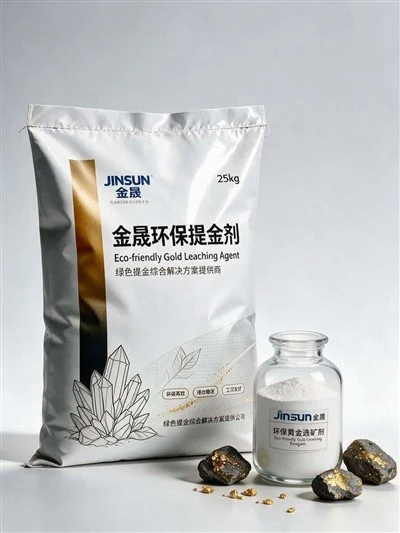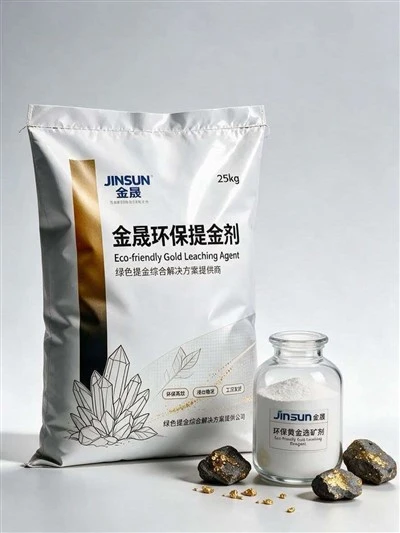
An environment friendly gold leaching agent is an alkaline complex-salt reagent that replaces sodium cyanide in tank, heap and CIP gold circuits without adding free cyanide. This page covers what the chemistry actually is, the numbers from our third-party tests, the ores where it fails, and the five-step bench test that decides whether it belongs in your plant.
In short
- No free cyanide is added at any point. The molecule is a complex salt containing cyanide groups, so treat it as low-cyanide, not cyanide-zero - we say this on every page because most suppliers do not.
- Third-party numbers (report HJ202604215): tailings cyanide 296 → 42.77 mg/kg, leach solution cyanide 1.32 → 0.12 mg/L against a 5 mg/L limit, LD50 > 450 mg/kg against roughly 5 for sodium cyanide.
- Recovery is ore-specific. Oxide ores run 85% or better in bench tests, with one sample at 97.58%. Every incoming ore should be bottle-rolled before a purchase order is signed.
What "environmentally friendly" means here
The reagent is sodium carbonate (57.99%) with sodium thiocyanate trimer (36.5%), sodium chloride (5.00%), triiron carbide (0.01%) and water (0.50%), per the batch certificate of analysis. No free cyanide enters the process at manufacture or at dosing.
It does not mean the compound is cyanide-free at the molecular level. The complex contains cyanide groups and can dissociate weakly, releasing a small amount of free cyanide into solution. What changes is the magnitude: 0.12 mg/L measured after leaching, against 1.32 mg/L for a sodium cyanide control on the same ore.
Three practical consequences follow:
- Detox is cheaper and simpler. Tailings measured 42.77 mg/kg after the standard step, an 85.5% reduction from the 296 mg/kg baseline.
- Transport classification changes. Non-dangerous goods, no UN number (identification report 26202601205), which removes a compliance layer most cyanide substitutes cannot remove.
- It is not non-toxic. Low-toxicity and alkaline, still an industrial chemical requiring gloves, dust control and normal storage discipline.
Environment friendly gold leaching agent vs sodium cyanide
| Parameter | Sodium cyanide | ECA complex salt | Basis |
|---|---|---|---|
| Operating pH | 10–11 | 10.5–11.5 (stable 9–12) | Technical data sheet |
| Dose, oxide ore | 1–2 kg/t | 1.2–1.5 kg/t | Bench and plant |
| Dose, primary sulfide | 2–5 kg/t | 2–4 kg/t | Bench |
| Leach time | 24–72 h | 12–24 h | Comparison trial |
| Gold recovery | ore-specific | 85%+, up to 97.58% on selected samples | Comparison trial |
| Cyanide in solution | 1.32 mg/L | 0.12 mg/L | HJ202604215 |
| Cyanide in tailings | 296 mg/kg | 42.77 mg/kg | HJ202604215 |
| Acute oral LD50 | about 5 mg/kg | more than 450 mg/kg | HJ202604215 |
| Lime consumption | baseline | 33% lower | Comparison trial |
| Transport | Class 6.1, UN 1689 | non-dangerous, no UN number | Report 26202601205 |
On cost, honestly: the reagent is priced above sodium cyanide per tonne and its complexing strength is slightly weaker, so consumption runs modestly higher. What closes the gap is lime (about a third less), detox chemicals, and - in jurisdictions that restrict cyanide - the cost of not being allowed to use it. Whether it nets out cheaper depends on your ore and your local regulation, and should be calculated, not assumed.
Operating window
pH 10.5–11.5; dose 1.2–1.5 kg/t on oxide ore and 2–4 kg/t on primary sulfide; 12–24 h of leaching; pulp density 33–40% solids; dissolved oxygen 6–8 mg/L; temperature 10–35 °C; low-chloride, low-hardness process water. Below pH 9 the complex destabilises; below 10 °C kinetics slow markedly and leach time has to be extended.
Where an environment friendly gold leaching agent does not work
Being straight about this saves both sides a trial.
- High sulfur (5% and above) and arsenic ores. Sulfide and arsenopyrite encapsulate gold; no lixiviant reaches it. Pre-oxidation or finer grinding must come first.
- Carbonaceous ore. Active carbon preg-robs dissolved gold - 1 kg can adsorb 15–20 g. Add a blinding agent or treat separately.
- Strongly acid-consuming ores. The system is alkaline; an ore that eats lime will eat the economics with it.
- Very cold circuits. Below 10 °C, leaching slows to the point of impracticality.
- Anyone expecting a blind 1:1 substitution. It drops into existing tanks and CIP trains, but dose, pH setpoint and detox still need re-tuning on your ore.
How to test it on your ore
- Characterise first. Head grade in g/t is not enough. Run a diagnostic leach to find how much gold is free-milling, how much is locked in sulfide, how much sits in carbonaceous matter. If more than a fifth is locked, stop - the problem is comminution or pre-oxidation, not reagent selection.
- Split one sample. Same grind (P80) across all arms.
- Bottle-roll. 200–500 g per charge, 33–40% solids, pH adjusted to 10.5 with lime, reagent at 1.2 kg/t (oxide) or 2.5 kg/t (sulfide). Roll 24 h, sample solution at 2, 6, 12 and 24 h.
- Run a cyanide control. A reagent trial without a cyanide baseline tells you nothing about the swap.
- Measure four things, not one. Gold in solution, reagent consumption, lime consumption, and residual cyanide in both solution and solids after detox. The last number is the one your regulator will ask about.
Frequently asked questions
Is it really cyanide-free?
No free cyanide is added, and none is present as a free salt. The complex molecule contains cyanide groups that can dissociate weakly; measured solution cyanide was 0.12 mg/L. "Cyanide-free" in this industry means no free cyanide added, not zero cyanide atoms - be skeptical of anyone who claims the latter.
Can it replace sodium cyanide without changing equipment?
In most tank, heap and CIP circuits, yes - same tanks and agitation. Dose, pH setpoint and the detox step still need re-tuning, and a bench test is mandatory before a plant trial.
What recovery can I expect?
On oxide ore, 85% or better is typical, with selected samples reaching 97.58%. On sulfide ore the ceiling is set by liberation, not by the reagent.
Is it cheaper?
Per tonne of reagent, no. Per tonne of ore, sometimes: lime drops about a third, detox is simpler, and in cyanide-restricted jurisdictions the alternative is not a cheaper reagent but a different process.
How is it shipped and stored?
Non-dangerous goods, no UN number, in 25 kg bags, 1,000 kg jumbo bags or IBCs; 26 t per 20 ft container. Shelf life 12 months, sealed and dry, away from acids and heat.
Next step
Send a 2–5 kg sample of your ore with the assay sheet. We run a bottle-roll against a cyanide control and return the recovery curve, reagent consumption and residual cyanide figures - the four numbers above - rather than a brochure.
Product page: Environment Friendly Gold Leaching Reagent - specification and packaging
Jinsun Chemical (Guangdong) Co., Ltd., Guangzhou, China. Sources: third-party test report HJ202604215 (Zhongke Testing, 20 May 2026); dangerous-goods identification report 26202601205; batch COA and MSDS.